Joint Winter School NTU Singapore – Sorbonne University | AI for Sciences
A week dedicated to AI-driven scientific research
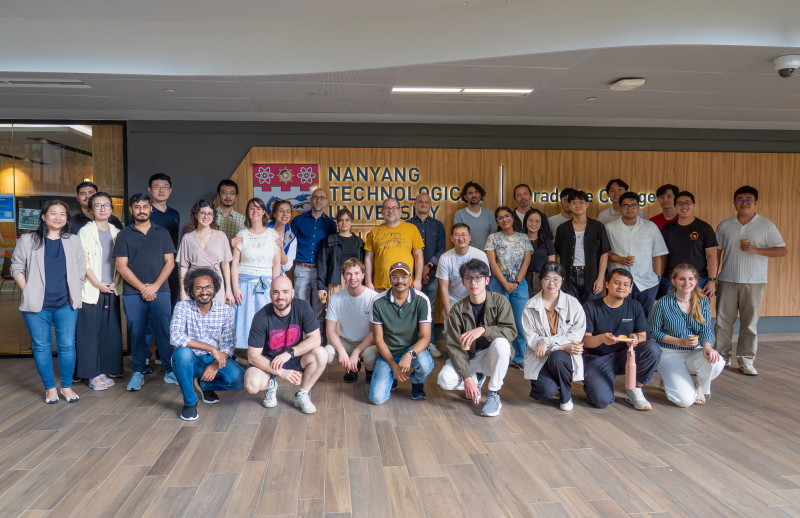
From 26 to 30 January 2026, the main campus of Nanyang Technological University (NTU) Singapore hosted the Joint Winter School NTU Singapore – Sorbonne University | AI for Sciences. This five-day intensive workshop brought together doctoral students and faculty members from both institutions to explore how artificial intelligence (AI) is transforming contemporary scientific research.
Jointly organised by the College of Science at NTU Singapore and Sorbonne University, the Winter School reflects a shared ambition to strengthen international scientific cooperation and to promote interdisciplinary approaches at the intersection of AI and STEM disciplines.
An interdisciplinary and hands-on programme
Designed as an immersive learning experience, the Winter School combined lectures, hands-on practical sessions, and collaborative discussions, allowing participants to engage directly with AI tools and methodologies applied to scientific research.
The programme covered a broad spectrum of topics:
- Introduction to AI concepts and tools
- Machine learning and its scientific applications
- AI in imaging analysis
- Data science in biomedical and other scientific fields
- Student-led projects and final presentations
Throughout the week, participants worked on concrete use cases drawn from biology, chemistry, environmental sciences, mathematics, physics, and engineering, encouraging cross-disciplinary dialogue and shared problem-solving.
A platform for collaboration and exchange
Beyond technical training, the Winter School offered a unique platform for intellectual exchange and collaboration. PhD students from both universities interacted closely with peers and faculty members from different scientific backgrounds, fostering new perspectives on how AI can be integrated into their respective research domains.
Group work and project-based learning played a central role, culminating in student project presentations that highlighted innovative applications of AI to real scientific challenges.
Strengthening international academic ties
This Joint Winter School illustrates the strong and growing partnership between Sorbonne University and NTU Singapore, and more broadly, the importance of global collaboration in addressing complex scientific questions.
By bringing together researchers from Europe and Asia in an intensive and collaborative setting, the event contributed to building lasting academic networks and to training the next generation of scientists in advanced AI-driven research methods.