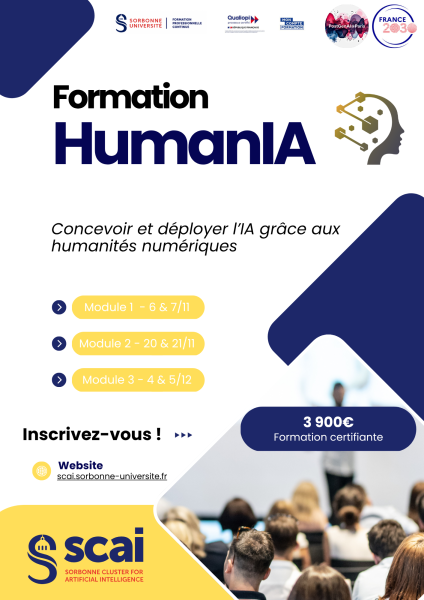
HumanIA : Certificate program - "Designing and Deploying AI through Digital Humanities"
HumanIA
"Designing and Deploying AI through Digital Humanities"
Training Objectives
- Understand artificial intelligence systems (Module 1)
- Master the ethical challenges of AI (Module 2)
- Deploy and use AI tools (Module 3)
Format & Logistics
- Duration: 6 days (2 days/module)
- Format: Online / Hybrid / In-person
- Dates: See training calendar below
- Location: SCAI – Sorbonne Center for Artificial Intelligence, 4 Place Jussieu, 75005 Paris
Target Audience: AI system deployers and users; project managers, engineers, researchers, legal experts, journalists, policy makers, civil servants, etc.
Curriculum
Module 1 – Understanding AI Systems
Thursday, November 6, 2025
- 8:30 AM – Welcome coffee
- 9:00 AM – Opening remarks – Gérard Biau, Director of SCAI, Professor at Sorbonne University, Member of the French Academy of Sciences
- 9:30 AM – Introduction to machine learning, deep learning, and NLP – Xavier Fresquet (Deputy Director of SCAI) & Nicolas Thome (Professor, Sorbonne University)
- 11:00 AM – Explaining AI outcomes – Marie-Jeanne Lesot, Professor, Sorbonne University
- 1:00–2:00 PM – Lunch break
- 2:00 PM – History of technology and artificial intelligence – Pascal Griset, Professor, Sorbonne University
- 4:00 PM – Case study: Multilingualism in NLP – Gaël Lejeune, Sorbonne University
- 6:00 PM – End of day
Friday, November 7, 2025
- 8:30 AM – Welcome coffee
- 9:00 AM – History of technology and AI – Benjamin Thierry, Associate Professor, Sorbonne University
- 11:00 AM – Human–machine interaction – Clothilde Chevet, Faculty of Arts, Sorbonne University
- 1:00–2:00 PM – Lunch break
- 2:00 PM – Geopolitics of AI – Philippe Boulanger, Professor, Sorbonne University
- 4:00 PM – Case study: Digital Delacroix – Barthélémy Jobert (Professor, Sorbonne University) & Nicolas Leys (Institut des Sciences du Calcul et des Données)
- 6:00 PM – End of day
Module 2 – Mastering the Ethical Challenges of AI
Thursday, November 20, 2025
- 8:30 AM – Welcome coffee
- 9:00 AM – Ethics and philosophy of science – Anouk Barberousse, Professor, Sorbonne University
- 10:30 AM – Ethics of artificial intelligence – Jean-Cassien Billier, Associate Professor, Sorbonne University
- 12:00 PM – Sociology of artificial intelligence – Pierre-Marie Chauvin, Associate Professor, Sorbonne University
- 1:00–2:00 PM – Lunch break
- 2:00 PM – Language, linguistics and AI – Motasem Alrahabi, Research Engineer, Sorbonne University
- 4:00 PM – Case study: Digital reconstruction of Notre-Dame (Plémo 3D)
- 6:00 PM – End of day
Friday, November 21, 2025
- 8:30 AM – Welcome coffee
- 9:00 AM – Discrimination and AI – Raphaële Xenedis, Associate Professor, Sciences Po Paris
- 11:00 AM – Sociology of AI – Jean-Philippe Cointet, Professor, Sciences Po Paris
- 1:00–2:00 PM – Lunch break
- 2:00 PM – Case study: AI and artistic creation – Xavier Fresquet (SCAI), Jérôme Nico, Nicolas Obin (IRCAM), Obvious / Hugo Caselles-Dupré
- 5:00 PM – End of day
Module 3 – Deploying and Using AI Tools
Thursday, December 4, 2025
- 8:30 AM – Welcome coffee
- 9:00 AM – Education, teaching and AI – Laurent Petit, Professor, Sorbonne University
- 11:00 AM – The role of ethics in the workplace – Adrien Tallent, PhD candidate, Sorbonne University
- 1:00–2:00 PM – Lunch break
- 2:00 PM – Deploying AI tools in organizations – Céline Gainet, Associate Professor, Sorbonne University
- 3:30 PM – Case study: Implementing technical standards – AFNOR
- 5:30 PM – End of day
Friday, December 5, 2025
- 8:30 AM – Welcome coffee
- 9:00 AM – AI law – Arnaud Latil, Associate Professor, Sorbonne University
- 11:00 AM – Copyright law and AI – Speaker to be confirmed
- 1:00–2:00 PM – Lunch break
- 2:00 PM – Case study: AI for justice
- 5:30 PM – End of day
Trainers & Speakers
The sessions are led by university professors, researchers and professionals specialized in AI, digital humanities, sociology, ethics, and digital transformation.
Certification
Final assessment (multiple-choice quiz) leading to a digital certificate of completion.
Teaching Methods
- Mix of theoretical content and hands-on sessions
- Active and flipped learning
- Individual and group mini-projects
- Teaching materials: slides, videos, readings, exercises, notebooks
- Participants must bring their own laptops.
- Some software installations may be required – detailed instructions will be provided in advance.